By early political standards in Nigeria, the public unveiling of Local Government Area coordinators by the Renewed Hope Ambassadors – Akwa Ibom State is not routine. It is strategic. It signals a deliberate attempt to shape voter perception long before campaign season formally begins.
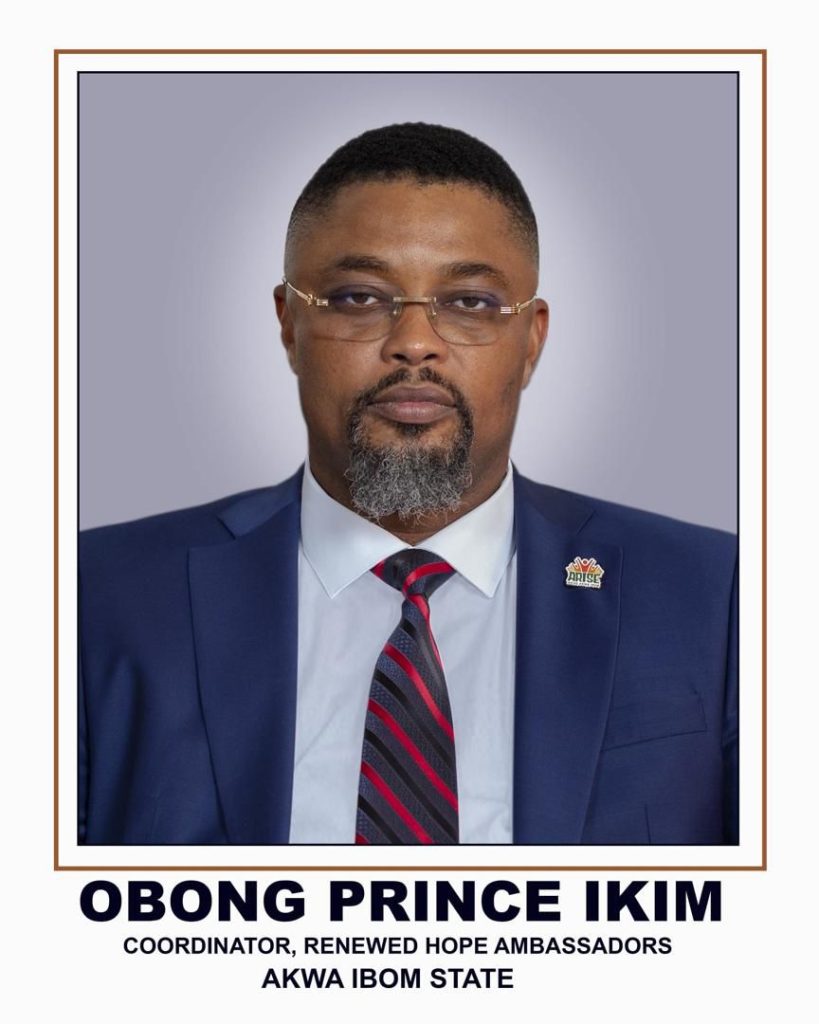
The Renewed Hope Ambassadors, a political support platform aligned with President Asiwaju Bola Ahmed Tinubu and the ruling All Progressives Congress, say their structure is built around early engagement rather than last minute mobilisation. In an interview published by the Akwa Ibom APC Newsletter, the group’s state coordinator, Obong Prince Ikim, framed the announcement of LGA coordinators as evidence of operational readiness rather than symbolic positioning.
It is noted that this approach reflects lessons from recent Nigerian elections, where late entry into grassroots engagement often left parties struggling to counter entrenched narratives. In states like Akwa Ibom, where party loyalty has historically leaned away from the APC at the presidential level, early groundwork matters more than media visibility.
Ikim’s emphasis on continuous engagement highlights a growing shift in political strategy. Instead of episodic rallies, the Renewed Hope Ambassadors aim to maintain a permanent presence at ward and community levels. Their coordinators are tasked with explaining government policies, gathering local feedback, and responding to public concerns in real time. This mirrors modern campaign models where persuasion begins years before ballots are cast.
The group’s messaging strategy also reflects an awareness of current economic realities. Nigeria’s reform environment has produced mixed public sentiment, especially around cost of living pressures. Rather than avoiding these issues, Ikim argues that grassroots actors must contextualise reforms, explain trade offs, and sustain dialogue. This approach recognises that silence at the community level often allows opposition narratives to harden.
From a behavioural perspective, Nigerian voters respond strongly to familiarity and access. Political support groups that remain visible between election cycles often gain credibility, even in opposition strongholds. The Renewed Hope Ambassadors appear to be positioning themselves as a constant interface between the federal government’s agenda and everyday voters in Akwa Ibom.
This strategy also serves an internal party function. Early coordination allows the APC to identify loyal structures, resolve internal conflicts quietly, and avoid fragmentation during primaries. In previous cycles, internal disputes weakened party performance more than opposition strength. Early mobilisation helps reduce that risk.
Nationally, similar patterns are emerging across APC controlled and non APC states. Pro Tinubu platforms are consolidating networks, training volunteers, and standardising policy messaging. This reflects a broader attempt to convert incumbency into organisational advantage, rather than relying solely on federal power or campaign funding.
Opposition parties are also watching these developments closely. Coalition talks, realignments, and early mobilisation efforts suggest that 2027 will not be decided by late momentum. It will likely be shaped by who controls narratives at the grassroots level over time.
In Akwa Ibom, the Renewed Hope Ambassadors are betting that sustained presence will soften political resistance and reframe national policies through local experience. Whether this translates into electoral gains remains uncertain. What is clear is that the contest for 2027 has already moved beyond speculation and into structured political groundwork.