Fresh Restatement Amid Ongoing Tensions
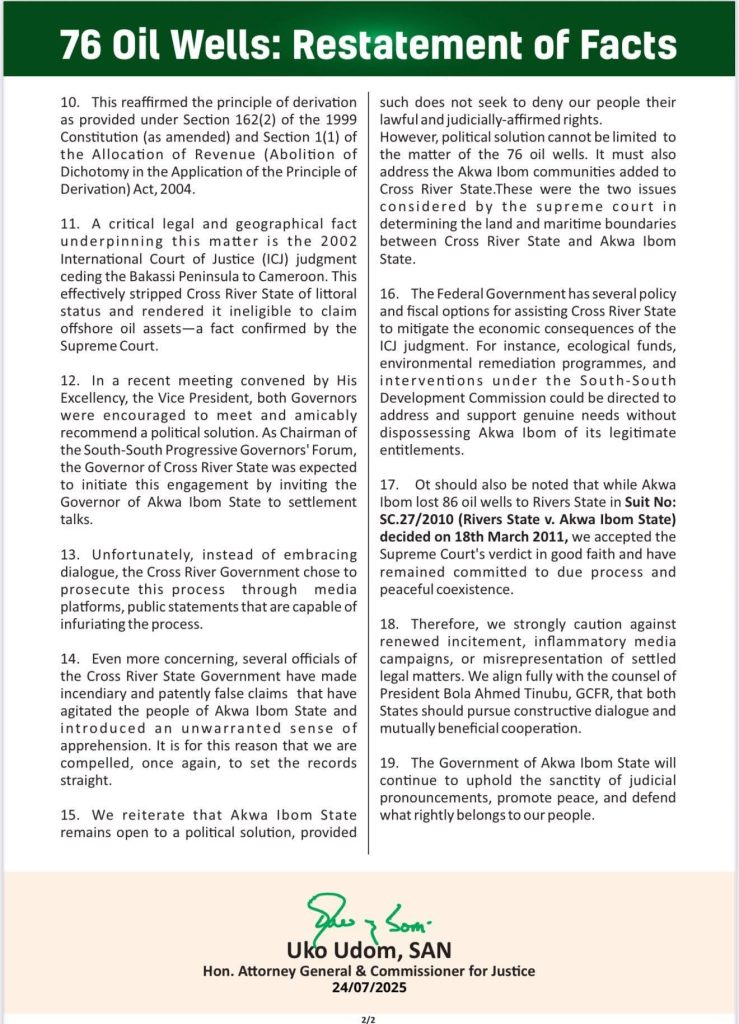
The Akwa Ibom State Government, through its Attorney General and Commissioner for Justice, Uko Udom, SAN, has issued a comprehensive clarification regarding the protracted debate over the ownership of 76 offshore oil wells. The move comes in response to renewed petitions and what it labels as misinformation and incitement from the Cross River State Government, which the Akwa Ibom authorities maintain threatens peaceful coexistence and distorts established facts.

Legal Proceedings: Setting the Record Straight
- Contrary to certain narratives, the Government of Akwa Ibom did not initiate any legal battle over the disputed oil wells. The record shows that it was Cross River State which instigated and subsequently lost two legal cases against Akwa Ibom.
Key Legal Milestones
- First Case – Suit No. 124/1999:
Cross River State sued Akwa Ibom over boundaries—both regarding 24 villages in the north and the southern estuarine boundary where the disputed oil wells are located. On 24 June 2005, the Supreme Court ruled in favour of Cross River State only on the matter of the northern villages, dismissing their claims over the oil-rich southern territory. “The effect of the judgment of ICJ dated 10/10/2002… is that it has wiped off what used to be the estuarine sector of Cross River State… Cross River no longer has a seaward boundary.” - Conciliatory Efforts:
The Government of Akwa Ibom attempted to settle the matter amicably, including a proposed monthly ex gratia payment of ₦250 million to Cross River from its derivation revenue. This offer, however, was rejected by Cross River State in a formal letter dated 27 March 2006. Efforts by elder statesmen to discourage litigation and preserve inter-state harmony were also rebuffed. - Second Case – Suit No. SC.27/2010:
Despite restraint from Akwa Ibom, Cross River State commenced another action, seeking clarity on revenue and ownership. After nearly three years, the Supreme Court on 10 July 2012, held: “The facts before the court do not support the claim of the plaintiff to being a littoral state. A non-littoral state cannot claim oil wells offshore, as it has no maritime boundary.” The Court reiterated that the principle of derivation under the 1999 Constitution and the relevant Revenue Allocation Act applied in favour of Akwa Ibom.
Impact of the ICJ Ruling
Central to the debate is the 2002 International Court of Justice (ICJ) judgment, which ceded the Bakassi Peninsula to Cameroon, effectively stripping Cross River State of its littoral (coastal) status and, by extension, grounds for laying claim to offshore oil assets. The Supreme Court consistently upheld this position.
The Call for Dialogue and Caution
Both State Governors were recently encouraged at a meeting convened by the Vice President to pursue a political solution, with expectations that Cross River would take the initiative. However, Akwa Ibom notes with concern that Cross River has chosen media campaigns and public statements over genuine negotiation—an approach it fears is inflaming public sentiment and jeopardising constructive engagement.
Officials from Cross River have made statements described by Akwa Ibom as inflammatory and false, necessitating a restatement of the facts to allay apprehensions among Akwa Ibom citizens.
Towards a Lasting Settlement
Akwa Ibom reaffirms its openness to political solutions—so long as these do not undermine the State’s judicially established rights. Any lasting arrangement, it stresses, should also address the issue of Akwa Ibom communities previously added to Cross River, which the Supreme Court weighed alongside the oil wells dispute.
Federal Government’s Role
The Akwa Ibom Government highlights that the Federal Government can support Cross River through ecological funds, remediation programmes or targeted interventions, without infringing on Akwa Ibom’s legitimate entitlements.
Acceptance of Other Judicial Outcomes
It is noteworthy that Akwa Ibom previously lost 86 oil wells to Rivers State in a related 2011 Supreme Court judgment. The State accepted the verdict in good faith, underlining its commitment to due process and peaceful relations with neighbours.
Final Statement
Akwa Ibom advises against renewed incitement or misrepresentation of settled legal outcomes. The State reaffirms its full alignment with President Bola Tinubu’s advice for constructive dialogue and mutually beneficial cooperation. The Government pledges to uphold judicial pronouncements, defend the rights of its people, and promote peace and stability.