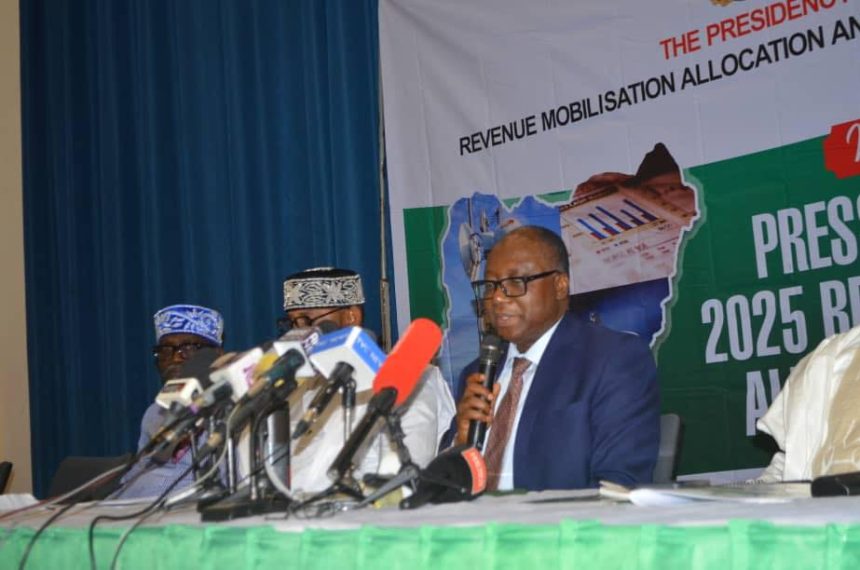
Abuja, 18 August 2025 – The Revenue Mobilisation Allocation and Fiscal Commission (RMAFC) has commenced a formal review of Nigeria’s Revenue Allocation Formula, the framework that governs the sharing of federally generated revenue among the three tiers of government.
Announcing the development at a press conference in Abuja on Monday, the Commission’s Chairman, Dr Mohammed Bello Shehu, OFR, described the exercise as a constitutional duty critical to ensuring equity and fairness in light of the country’s shifting socio-economic landscape.
“This exercise marks the formal start of a comprehensive review of the formula by which revenue is shared between the Federal, State, and Local Governments in Nigeria,” Dr Shehu said.
He recalled that the last holistic review was conducted in 1992, followed by incremental adjustments through executive orders from 2002 to date. He noted that over three decades of demographic growth, constitutional amendments, and economic transformation had heightened the relevance of a fresh evaluation.
In particular, Dr Shehu pointed out that recent constitutional reforms devolving key responsibilities—such as power generation, railway operations, and correctional services—to subnational governments had imposed fresh financial and administrative obligations on them. This, he argued, made the review imperative for safeguarding Nigeria’s fiscal stability and growth.
The Chairman stressed that the Commission’s objective was to deliver “a fair, just and equitable” sharing arrangement that reflects the present-day roles, responsibilities, and capacities of all tiers of government.
Similarly, the Chairman of the Revenue Allocation Formula Committee and Federal Commissioner representing Katsina State, Kabir Muhammad Mashi, OON, assured that the review process would be transparent, rigorous, and inclusive.
“This review is not simply about figures; it is about fairness and justice in resource distribution. We intend to consult widely with stakeholders—including the Presidency, the National Assembly, State Governments, the Association of Local Governments of Nigeria (ALGON), the Judiciary, Civil Society, the private sector, and international development partners. The process will be data-driven and aligned with international best practice,” he stated.
Mashi added that the Commission would employ scientific research and empirical data to guide its work, stressing that the exercise was designed to strengthen fiscal federalism and promote national cohesion.
The RMAFC reaffirmed its commitment to conducting the review in a transparent and inclusive manner, pledging to ensure that the eventual formula gains broad national acceptance.
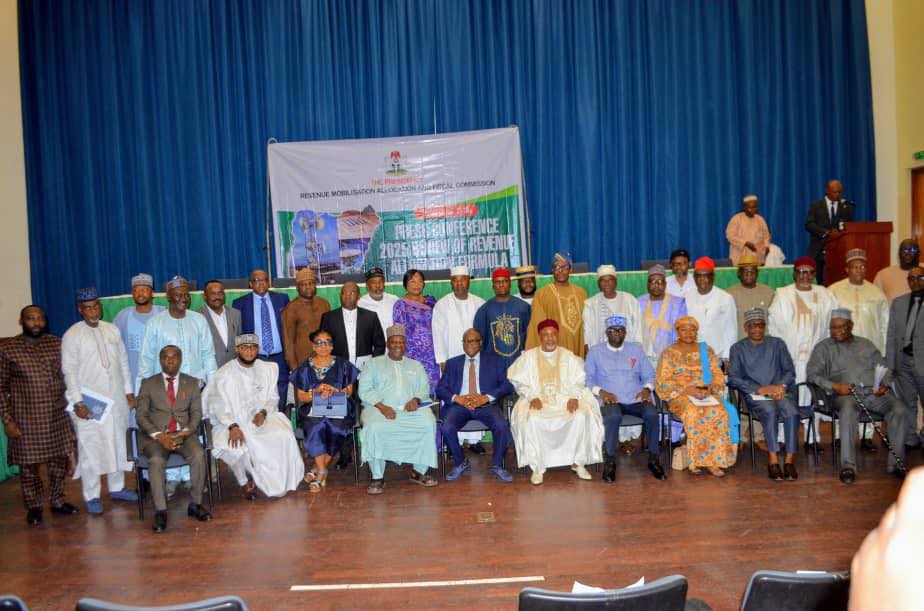
Stakeholders present at the event urged the Commission to anchor its work on the principles of true federalism and to link allocations more directly to infrastructure development across the country.