The Transformative Power of E-Governance and the Digital Economy
In today’s interconnected world, the nations and regions that embrace digital governance stand at the forefront of economic growth, efficiency, and global competitiveness. E-governance is the use of technology to deliver government services more effectively, ensuring transparency, accessibility, and citizen engagement. When implemented judiciously, it reduces bureaucracy, curbs corruption, saves costs, and delivers services faster.
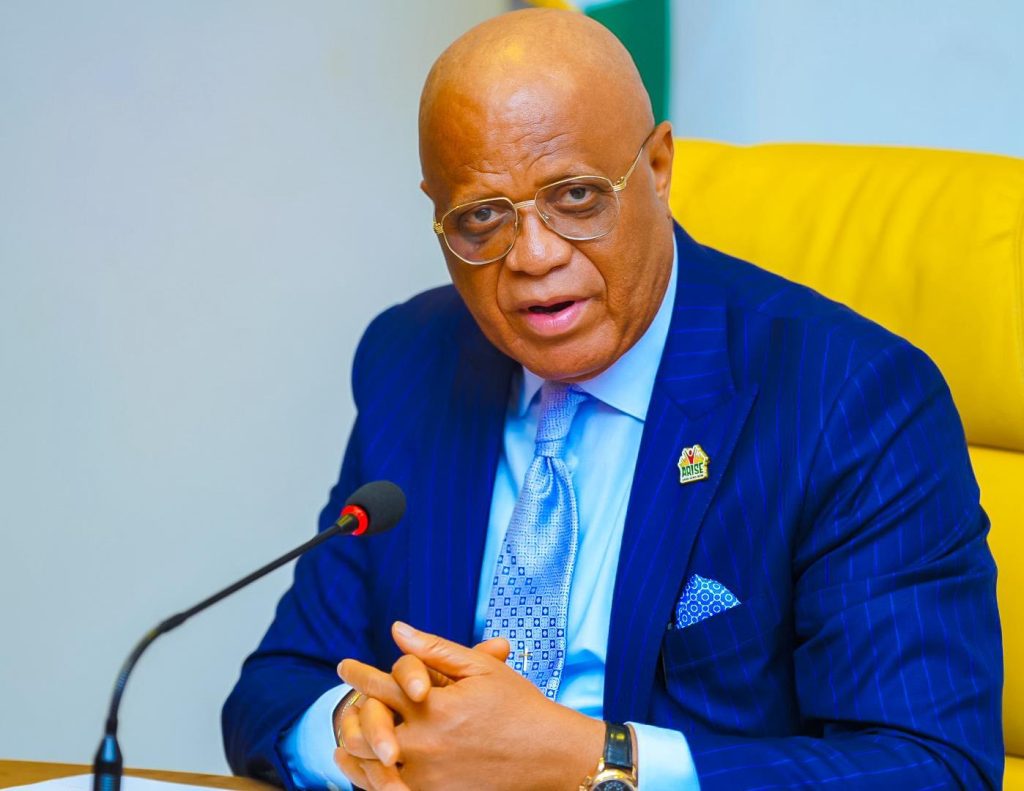
Governor Umo Eno
The digital economy, on the other hand, encapsulates all economic activities powered by digital platforms, data, and ICT infrastructure. It promotes job creation, business innovation, and market expansion—critical components of sustainable, inclusive growth.
Governor Umo Eno recognises that Akwa Ibom’s future lies beyond oil dependency. His vision is to harness technology as a driver of public service reform, economic diversification, and global visibility for the state. Between May 2023 and May 2025, his administration rolled out multiple e-governance and digital economy interventions which are reshaping Akwa Ibom into a 21st-century hub for efficiency, innovation, and opportunity.
This article speaks directly to “Governor Umo Eno’s Golden Footprint”—a compendium of his administration’s impact in the last 2 years. It captures the far-reaching effects of e-governance and digital economy initiatives implemented under his tenure, highlighting tangible transformations across Akwa Ibom State.
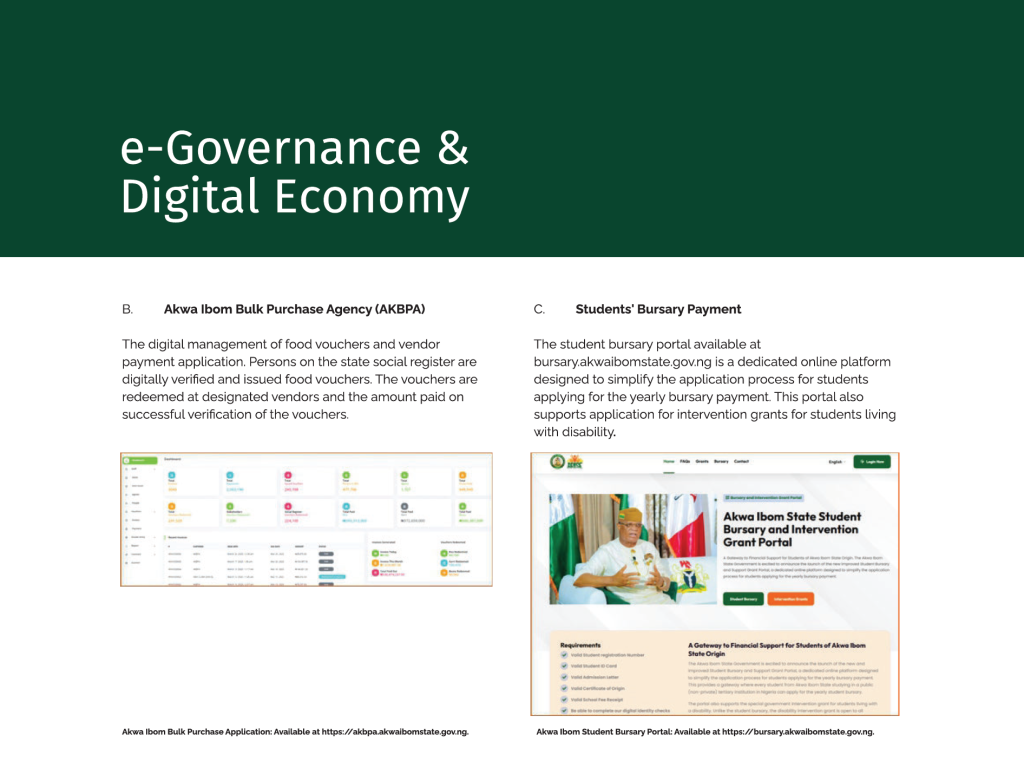
List of Akwa Ibom State Government websites facilating e-governance
Digitising Social Welfare: The Akwa Ibom Bulk Purchase Agency (AKBPA)
Under the Bulk Purchase Scheme, beneficiaries on the State Social Register are digitally verified and issued electronic food vouchers redeemable from approved vendors. Payments to vendors are processed electronically upon verification.
The result is striking. For a widow in Ikot Ekpene, gone are the days of long queues and delayed food support. Now, a mobile voucher grants her swift, dignified access to essentials, while vendors enjoy prompt, transparent payments. By eliminating leakages and ensuring that only verified beneficiaries receive support, the initiative has restored trust in public welfare programmes and improved efficiency in social interventions.
Empowering Education: The Student Bursary Payment Portal
The student bursary and disability grant portal simplifies access to state educational support. Akwa Ibom students in public tertiary institutions can now apply online, upload required documents, and track approvals in real time.
For example, a visually impaired student at the University of Uyo can now apply from her mobile phone without the stress or cost of travelling home. Her bursary is processed faster, enabling her to focus on academics rather than financial strain. This demonstrates how digital systems can level the playing field, broaden inclusion, and empower future talent.
Opening Doors for Youth: The Arise Youth Employment Portal
To address unemployment head-on, the Arise Youth Employment Portal links job-seekers with opportunities and provides N50,000 business start-up grants. Over 19,000 young people have already benefited.
Consider a young graduate in Oron who secures both a digital marketing job and a grant to launch a small e-commerce venture. This one intervention reduces unemployment, builds entrepreneurial capacity, and keeps talent within the state economy.
Modernising Land Administration: Akwa Ibom State GIS (AkwaGIS)
Land management in Akwa Ibom has undergone a quiet revolution with AkwaGIS, which enables fully digital land title registration and fee payment.
A real estate firm in Uyo that previously endured months of paperwork can now secure titles within weeks, unlocking new housing developments and attracting investor confidence. Secure digital documentation reduces fraud, increases transparency, and stimulates construction-led job growth.
Strengthening Small Businesses: MSMEs Grant Portal
The administration launched a dedicated MSMEs digital registration platform tied to a ₦5.1bn state support fund.
For instance, an agro-processing entrepreneur in Uyo registers on the platform, secures a grant, and scales up production. She hires new employees and begins supplying packaged goods to emerging retail points—demonstrating how strategic funding married to transparent digital processes helps grassroots businesses thrive.
One Secure Identity: Akwa Ibom Electronic ID (AKeID)
With AKeID, residents have a secure, verifiable digital identity to access multiple government services without repeatedly submitting personal details.
A retired teacher accessing pension verification from her rural community can now do so with just her AKeID number. This reduces travel costs, streamlines service delivery, and builds a state-wide trusted identity system—paving the way for future digital innovations.
Transparent Contracting: Procurement and Public Servant Verification Portals
By digitising procurement, Akwa Ibom ensures that only qualified contractors bid for state projects through an open online process—removing the opacity historically associated with government contracts.
At the same time, digital verification of public servants has eliminated over 2,000 ghost workers from the payroll, freeing up funds for development projects while keeping genuine employees protected.
A legitimate Uyo-based contractor can now submit bids without fear of favouritism, confident that selection is merit-based—a massive boost to private sector confidence and governance integrity.
Caring for Pensioners: Pension and Generic Verification Portals
Pension verification, once stressful for the elderly, is now quick and flexible. Local government walk-in centres and remote verification options mean pensioners no longer travel to Uyo unnecessarily.
An elderly ex-civil servant in Oruk Anam can complete verification in minutes at a local centre and receive pensions promptly each month, significantly improving quality of life for senior citizens.
Building the Digital Backbone: Fibre Broadband Rollout
Perhaps the most critical enabling project is the MainOne–Equinix undersea cable landing in Ibeno, which delivers high-speed fibre connectivity to government offices, schools, and hospitals.
This backbone infrastructure fuels telemedicine in rural clinics, e-learning platforms in schools, and cloud-based public administration. A teacher in Eket can now stream educational resources for her pupils without interruption—bringing global knowledge to local classrooms.
Why Gov. Umo Eno’s Digital Push Matters
The governor’s interventions are more than technology projects—they are structural enablers for a modern economy. By embedding transparency, reducing service delivery friction, and promoting inclusivity, digital governance attracts investors, elevates public trust, and connects Akwa Ibom to global markets.
From social protection to real estate, from youth empowerment to business support, and from secure identity systems to high-speed fibre optics, these reforms demonstrate that technology, when strategically applied, does far more than automate—it transforms lives.
The vision is clear: an Akwa Ibom where governance is service-driven, citizens are digitally empowered, and the economy thrives on innovation rather than dependency. If sustained, these steps will position the state not just as a Nigerian leader in e-governance, but as a competitive force in the African digital economy.
Destiny Young, an IT Professional and Cybersecurity expert, writes from Uyo